It has been roughly 20 years since Kyoto University’s Professor Shinya Yamanaka and colleagues first reported the creation of iPS cells (induced pluripotent stem cells) in 2006. In March 2026, regenerative medicine products using iPS cells were approved in Japan for the first time in the world, and the practical application of this research is steadily advancing. At this milestone, we revisit the history of iPS cell research and its latest developments.
Key points of this article
iPS cells are created by introducing several genes into body cells such as skin cells, giving them the ability to change into various types of cells. About 20 years after their 2006 announcement, in March 2026, two regenerative medicine products — targeting heart failure and Parkinson’s disease — received the world’s first conditional, time-limited approval in Japan. Research has entered a new stage toward the next 20 years.
First, a note on terms: medical “iPS cells” and iPS-X’s “iPS stem cells”
Before getting into the main topic, let us clarify the terms. The “iPS cells” discussed in this article belong to regenerative medicine (the medical field). The “iPS stem cells” on which the skincare brand iPS-X focuses belong to the beauty (skincare) context. The names are similar, but they refer to different fields, as shown below.
| Medical “iPS cells” | iPS-X’s “iPS stem cells” | |
|---|---|---|
| Field | Regenerative medicine (medical / treatment) | Skincare (beauty) |
| How they are used | Treatment and research at medical institutions | Everyday skincare |
| Relation to iPS-X | The topic of this article (a separate field from our products) | The concept the brand focuses on |
| On formulation | — | Does not contain iPS stem cells themselves; contains the culture supernatant produced when they are cultured |
To avoid any misunderstanding — about iPS-X skincare
DDS iPS-X is skincare, not a pharmaceutical or medical device. It does not contain iPS stem cells themselves; rather, it contains the culture supernatant (culture fluid) produced when iPS stem cells are cultured. It does not indicate any medical effect. This is clearly distinct from the iPS cells as regenerative medicine discussed in this article.
With this distinction in mind, let us now look at 20 years of “iPS cells” in medicine and research, and the latest developments.
What Are iPS Cells? — From a Discovery 20 Years Ago
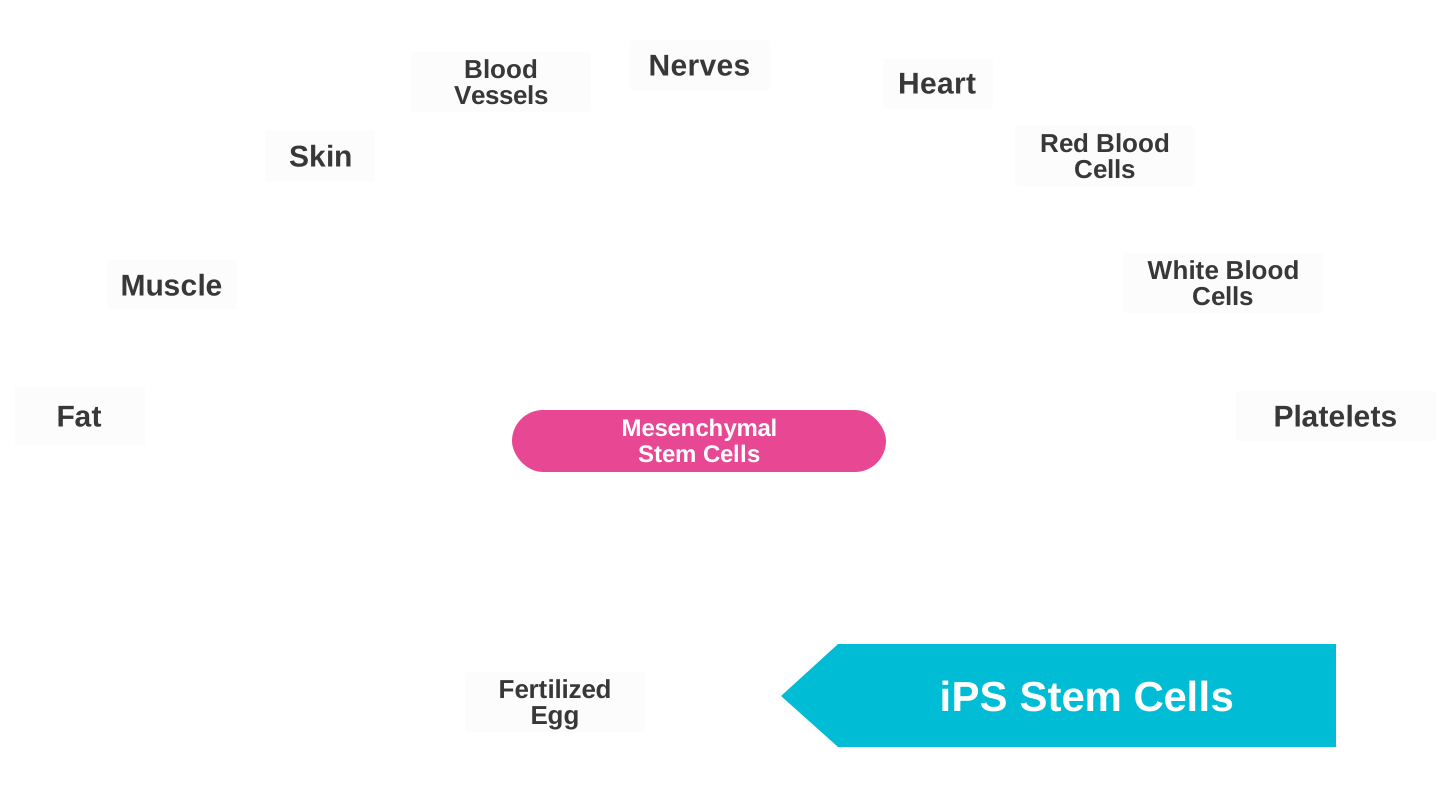
iPS cells (induced Pluripotent Stem cells) are body cells — such as skin or blood cells — into which specific genes have been introduced, giving them the ability (pluripotency) to change into many different types of cells in the body. In 2006, Professor Shinya Yamanaka and colleagues at Kyoto University reported their creation in mice, and the following year, in 2007, success with human cells was announced. For this achievement, Professor Yamanaka received the Nobel Prize in Physiology or Medicine in 2012.
Until then, the cells known for their ability to change into a wide range of body tissues were ES cells (embryonic stem cells), derived from fertilized eggs. Because iPS cells can be made from a patient’s own cells, they are considered better able to avoid immune rejection and certain ethical concerns, and they have drawn worldwide attention as a promising option for regenerative medicine.
It is said that the lowercase “i” in “iPS” carries a wish that these cells would become widely familiar, much like the popular portable music players of the time. Even as a highly specialized technology, its very name reflects an intention to remain open and accessible to society.

2026: The World’s First Regenerative Medicine Products Approved
In March 2026, Japan’s Ministry of Health, Labour and Welfare granted conditional, time-limited approval for the manufacture and sale of two regenerative medicine products using iPS cells. This is the world’s first approval of therapeutic products using “Japan-born” iPS cells.
The two approved products are a cardiac muscle cell sheet for severe heart failure (heart-muscle cells made from iPS cells, formed into a sheet for use on the heart) and a treatment for Parkinson’s disease (transplanting neural progenitor cells made from iPS cells into the brain). Both were approved under a “conditional and time-limited approval” framework, and their safety and efficacy remain at a stage where further verification will continue.
About 20 years passed from the 2006 announcement to practical use. In medical research, it commonly takes many years for a new treatment to gain approval, so the fact that a new technology like iPS cells has begun reaching clinical settings within this period is regarded as a major milestone. At the same time, those involved in the research note that this is merely the halfway point of a long journey, and that the real challenge lies ahead.
The Expanding Fields of iPS Cell Application
Beyond the heart failure and Parkinson’s disease products approved this time, research applying iPS cells is advancing across a wide range of fields. Reported examples include applications to diseases for which effective treatments have been limited, such as diabetes, retinal disorders, knee osteoarthritis, and spinal cord injury.
In addition, supporting efforts toward practical use are also progressing — such as research to expand immune cells that fight cancer using iPS cell technology, and the development of automation technologies for producing cells stably and at scale. Unlike conventional, chemically synthesized medicines, cell-based medicine still relies heavily on human hands for much of the cell-production process, so establishing technologies that enable mass production is considered key to practical application. The government is also investing in strengthening the manufacturing base for regenerative medicine, raising expectations for accelerated research.
The Importance of “Communicating Research”
At the 20-year milestone of iPS cell research, the Center for iPS Cell Research and Application (CiRA) at Kyoto University has spoken about the importance of helping more people understand the significance of the research. No matter how excellent the research, unless its value is truly “communicated” to society, the circle of support and empathy will not grow. Finding ways to convey often-complex science — delivering the conclusions in an accessible way — is seen as a force that will support research going forward.
iPS cells are a technology born in Japan. As international competition intensifies, passing the research on to the next generation requires not only securing funding and talent but also the understanding and interest of society as a whole. At the forefront of research, there is renewed awareness of the importance of communicating not just results, but also the hardships and trial-and-error that led to them.
Toward the Next 20 Years
iPS cell research has moved from basic science toward practical application, reaching a major milestone in 2026. At the same time, many challenges remain for the next stage — including further verification of safety and efficacy, stable cell production, and building the systems that support the research.
Over these 20 years, the term “iPS” has changed from something belonging only to researchers into a word widely shared across society. What will iPS cell research reveal to us over the next 20 years? Attention continues to focus on the journey of this Japan-born technology.
References & Sources
This article is organized and composed based on publicly available information from the following public institutions, news organizations, and others. For details, please refer to each primary source.
- Center for iPS Cell Research and Application (CiRA), Kyoto University, “iPS Cell 20th Anniversary Roundtable”
- JST Science Portal, “Government approves regenerative medicine products using iPS cells for the first time”
- Center for iPS Cell Research and Application (CiRA), Kyoto University, “What are iPS cells? (FAQ)”